Bioeconomy Policy
Biomanufacturing Scale Up
China's Bioeconomy Is Brewing Its Biggest Wave Yet

Start with a number: 70% of the world’s fermentation capacity is in China. Not a significant share. Not a growing proportion. Seventy percent, and still growing.
If you work in biotech, biopharma, specialty chemicals, or industrial biology, you live downstream of that fact whether you know it or not. The therapeutics licensing wave has been making headlines: Chinese biotechs licensing drugs to Western pharma at a pace nobody predicted five years ago. But that wave is the visible exhaust of something much larger. China has spent more than two decades building a full-stack bioeconomy across industrial chemicals, materials, food ingredients, and energy, with therapeutics as only the most recently visible layer. Most people in the West are watching the output. Almost nobody is watching the machine producing it.
I recently helped the European Council on Foreign Relations think through the other half of this question: what should Europe actually do about it. That piece, The Future Is Fermented, came out last week and lays out where Europe still has a real shot at competing. This piece is the machine ECFR’s report is responding to: how it was built, what it’s already captured, and what’s coming next.
The Three Waves
The most useful way I have found to understand the Chinese biotech ecosystem is not as a single event but as three sequential waves, each built on an enabling layer that made it possible and a product layer that made it profitable. All three are now active simultaneously.
Wave 1 is already over.
The enabling layer was engineering excellence, cheap CapEx, government industrial parks, and abundant fermentation infrastructure. The product layer was amino acids, bulk chemicals, nutraceuticals, and fermentation-derived food ingredients. Companies like Meihua, Fufeng, Cathay, Anhui Huaheng Bio, and CABIO were founded in the late 90s and early 00s. They built competitive positions not through novel science but through operational discipline and cost structures that incumbents in Japan and Europe could not match.
Fufeng and Meihua are reported, in my interviews with industry sources in China, to have displaced Japanese incumbents Ajinomoto and Kyowa Hakko from significant shares of the global amino acid markets on engineering excellence and cost (note I have not been able to independently verify exact market share figures so treat this as directional rather than confirmed). Anhui Huaheng Bio identified a market gap for L-alanine, developed its fermentation technology through the mid-2000s, and has now been supplying BASF for well over a decade, a relationship that has since deepened into a formal strategic cooperation agreement on agricultural nutrition, signed in May 2024, with BASF naming Huaheng its 2025 Strategic Partner of the Year. Cathay Industrial Biotech is one of the world’s leading producers of long-chain dicarboxylic acids, the building blocks of high-performance nylons; China as a whole holds roughly 30% of global LCDA production volume, and Cathay has continued to invest heavily in capacity, including a reported $500 million expansion at Wusu to double regional output.
The Japanese displacement story is not a warning from an adjacent sector. It is a completed case study of what happens when this wave arrives and the incumbent is not ready for it.
Wave 2 is happening now.
The enabling layer was a decade of deliberate regulatory reform. The CFDA overhaul in 2015 cleared a massive application backlog, cracked down on data fraud, and introduced the MAH system that unlocked new business models. China joined ICH in 2017, effectively drawing into closer alignment with the FDA and EMA. Alongside this, China built world-class biotech service infrastructure (Figure 1) and a wave of overseas-trained scientists returned to build therapeutic programmes domestically.
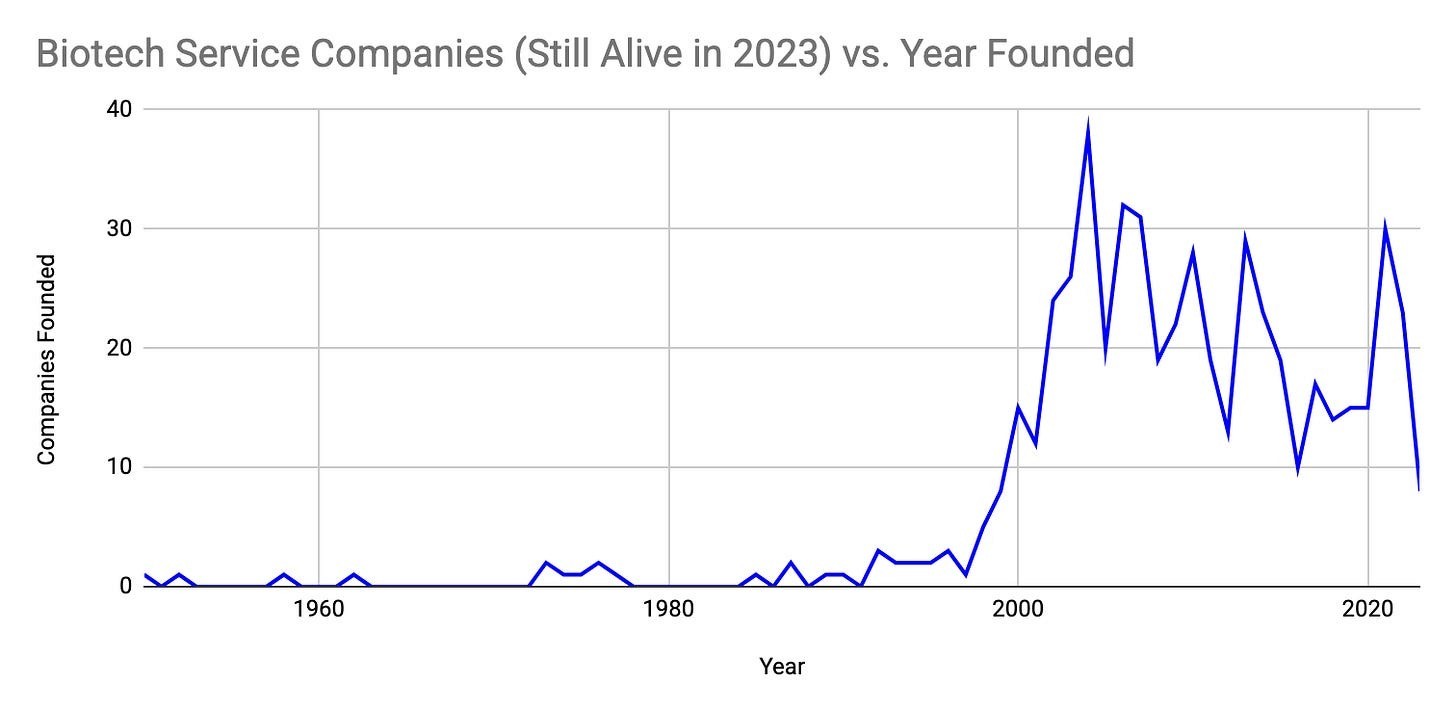
Figure 1: Biotech Service Companies (CRO, CDMO, CMO, Analytical) still alive in 2023 versus year founded. Source: Biotechgate.
The product layer is the licensing wave everyone is now tracking. In 2024, major pharma companies in-licensed 31% of their innovative pipeline assets from China, up from virtually zero five years earlier. By H1 2025, China accounted for 44.5% of global licensing deal value. GSK’s 2025 deal with Jiangsu Hengrui ($500 million upfront for a COPD drug and eleven additional candidates spanning oncology, immunology, inflammation, and respiratory disease) could reach $12 billion including milestones. AstraZeneca committed $2.5 billion to a Beijing R&D and manufacturing investment earlier in 2025, then in June signed a research collaboration with CSPC Pharmaceuticals: $110 million upfront, up to $1.62 billion in development milestones and $3.6 billion in sales milestones, built around CSPC’s AI-driven drug discovery platform for small-molecule treatments of chronic immunological disease. The average upfront payment for China-originated deals rose from $102 million to $141 million between 2024 and 2025 alone.
Development in China is widely assessed by industry analysts to be 2-5x faster and cheaper than in the West, an advantage rooted in NMPA’s 2015-2020 reforms rather than regulatory laxity. China’s dual-track system allows cell and gene therapy programmes to begin with investigator-initiated trials at hospitals, generating early human data well before a formal IND filing; a genuine structural speed advantage over the West’s single-track system. Chinese companies actively monitor Western patent filings and academic publications for new targets and move fast, as in the CD24 case, where Antengene started clinical trials in the US before Pheast Therapeutics had filed an IND for the same target, first published by Irv Weissman’s lab in 2019. The clock starts when you disclose.
Wave 3 is forming.
The enabling layer for Wave 3 has five parts, each one a cost or capability curve bending favorably at once:
First, AI and automation for biological design and discovery. Of the 16 companies named as AI × biomanufacturing pioneers by MIIT in 2025, 13 apply AI to biological design rather than downstream manufacturing: protein design, metabolic pathway optimisation, cell factory construction.
Second, the commoditisation of syn bio inputs. Dirk van der Kley has tracked how the core tools of biomanufacturing, gene sequencing, DNA synthesis, gene editing, are becoming commoditised as both the US and China pour money into tooling. GenScript, Tsingke, and Sangon have driven gene synthesis costs down globally; BGI’s DNBSEQ platform has broken Illumina’s near monopoly on sequencing cost in many markets.
Third, OpEx reductions in feedstock and energy. The non-food biomass programme is attacking the one structural cost disadvantage China had: cheap corn. The national bioreactor mission is engineering cheaper, higher performance fermentation hardware. Both compress the operating cost side of the biomanufacturing equation that Wave 1 spent decades fighting alone.
Fourth, distributed capability building. Rather than concentrating investment in a handful of national champions, the relevant programmes spread bets across dozens of organisations at once, a pattern that shows up again in the automated lab capacity being built out nationwide: at the Shenzhen Institute of Advanced Technology, the country’s largest dedicated synbio facility, several Beijing sites including one in Changping built with Danaher, and dedicated capacity at Fudan, Shanghai Jiao Tong, Zhejiang, and Tianjin universities and multiple CAS institutes.
Fifth, everything inherited from Wave 1 and Wave 2: the fermentation infrastructure, the CDMO networks, the regulatory pathway maturity, the returnee talent base.
All five of these rest on the same foundation I’ve laid out before in the Bioelectric Tech Stack: biology is the chemical manufacturing layer of an electrified economy, and the real question is not which country has the best biological tools but which has sequenced the underlying stack correctly, building energy and feedstock infrastructure first, before layering fermentation, sensing, and AI control on top. Western AI-for-biology investment concentrates in design because pharma’s small volumes and bespoke processes tolerate inefficiency elsewhere in the stack. China has built the lower layers first. That sequencing, moreso than any single tool, is what Wave 3 inherits.
The product layer is still forming. Tidetron Bioworks (founded 2021) produces materials, serving biomedical, cosmetics, and food industries. KansenBio, a 2022 Tsinghua spinout, makes ectoine and amino acids. Zhihe Biotechnology (2022) makes specialty oils and fats. Giant Biogene, making recombinant collagen on its own platform, is already listed on HKEX.
Several Wave 3 platforms are converging on the same molecules: many of which are already named as priorities in China’s industrial policy. This isn’t accidental duplication. It’s multiple well-funded entrants chasing the same government-identified targets at once, across cosmetics, food, chemicals, and materials. What follows is the same gauntlet that built Fufeng and Meihua: dozens of platforms fighting over the same molecules until only the efficient ones survive. And Fufeng and Meihua didn’t stay domestic once they won. They took Ajinomoto’s and Kyowa Hakko’s global share. The signal worth tracking isn’t which Wave 3 company looks impressive today. It’s which categories consolidate fastest inside China, because that’s the platform about to explode globally next.
What’s Already Been Captured
The therapeutic deals are well covered. What is less visible is that the non-pharma deals reveal a structurally different and arguably more consequential dynamic: supply chain capture rather than licensing.
Bloomage Biotech has been supplying Estée Lauder, L’Oréal, and Shiseido with fermentation-derived hyaluronic acid for nearly two decades, recognised as a world-renowned HA manufacturer by 2007. Cathay and Anhui Huaheng Bio, covered above, follow the same shape: multi-year industrial supply lines that long predate the headline partnerships that eventually made them visible.
These are not all recent deals. That is the point. A licensing deal is visible, negotiated, and can be unwound. Supply chain capture is structural. When the ingredient in your product has been coming from a Chinese fermentation facility for fifteen years, the relationship is different in kind, and hard to reverse quickly.
The deals above are not just evidence of capture. They are evidence of visibility. Bloomage, Cathay, and Anhui Huaheng Bio spent over a decade building and proving out fermentation capacity, feedstock access, and intermediate chemistry with Western customers, in full view of every domestic competitor watching how it was done. A Chinese startup founded today can see exactly where it would plug into that chain: which biomanufacturer to approach, which feedstock supplier already operates at scale, which customer relationship is already proven. A Western startup is often working out where the chain even is, let alone how to join it. That gap is exactly why the question “how much to source from China, how much to build elsewhere” now sits on the desk of nearly every Western syn bio founder I talk to. There’s no clean answer, and most land somewhere in between. But the deals themselves are what make the chain visible in the first place. One side can see the map. The other is still drawing it.
What the Patents Tell You
EPO analysis of synthetic biology applications from 2004 to 2023 shows China at 21% compound annual growth rate during 2014-23. The US grew at 10%, Germany at 4%, the UK at 9%. The explosion began around 2018 and has continued to accelerate.
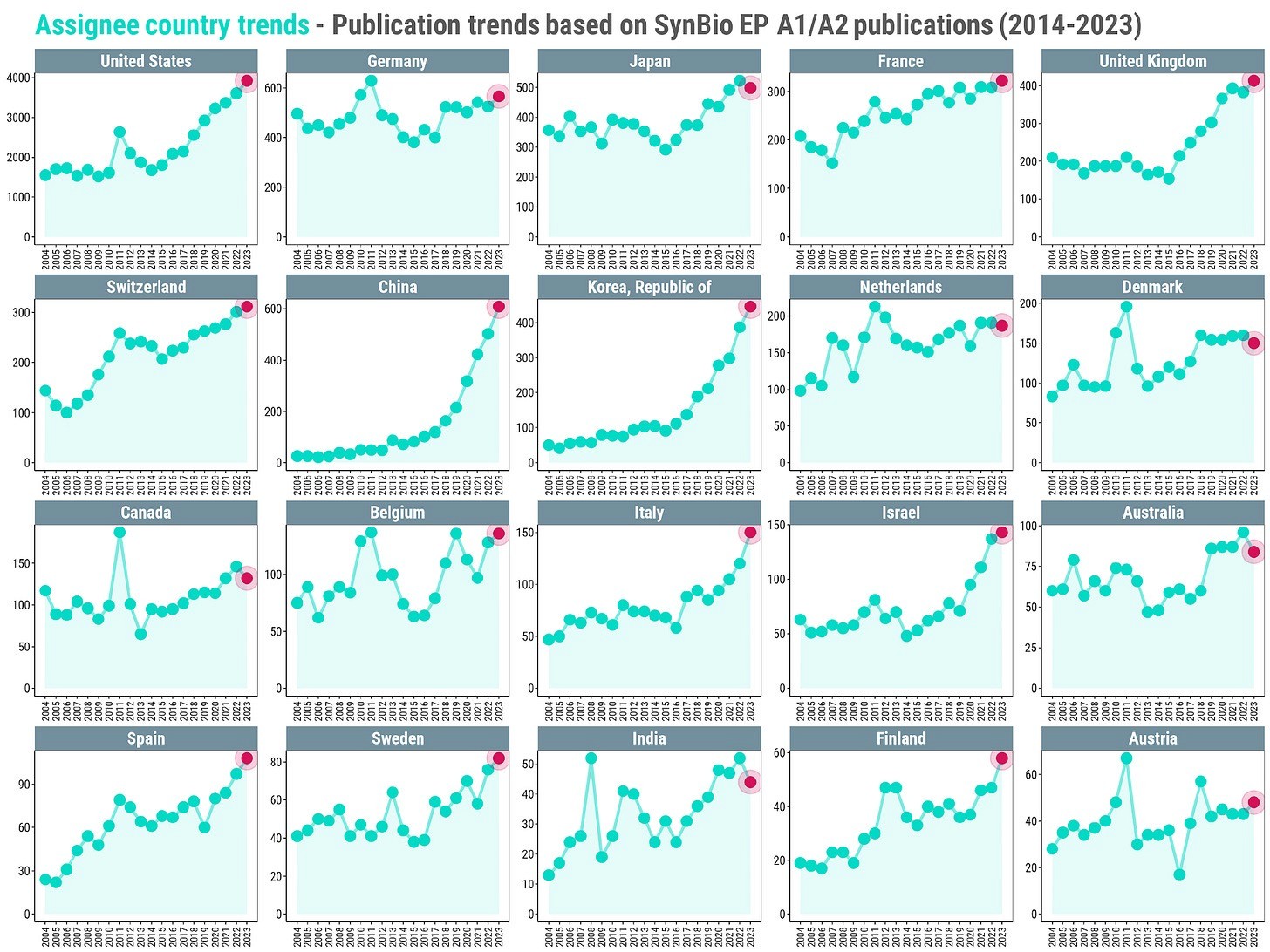
Figure 2: EPO analysis of Synthetic Biology Patents from 2004 to 2023.
The topic breakdown is primarily therapeutic: antibodies first, fusion proteins fourth, pharmaceuticals fifth, drug delivery sixth, immunotherapy ninth. That directly explains the shape of the Wave 2 licensing boom. But underneath the therapeutics topics, genetically modified microorganisms rank third and CRISPR appears in the top 20: the substrate of Wave 3.
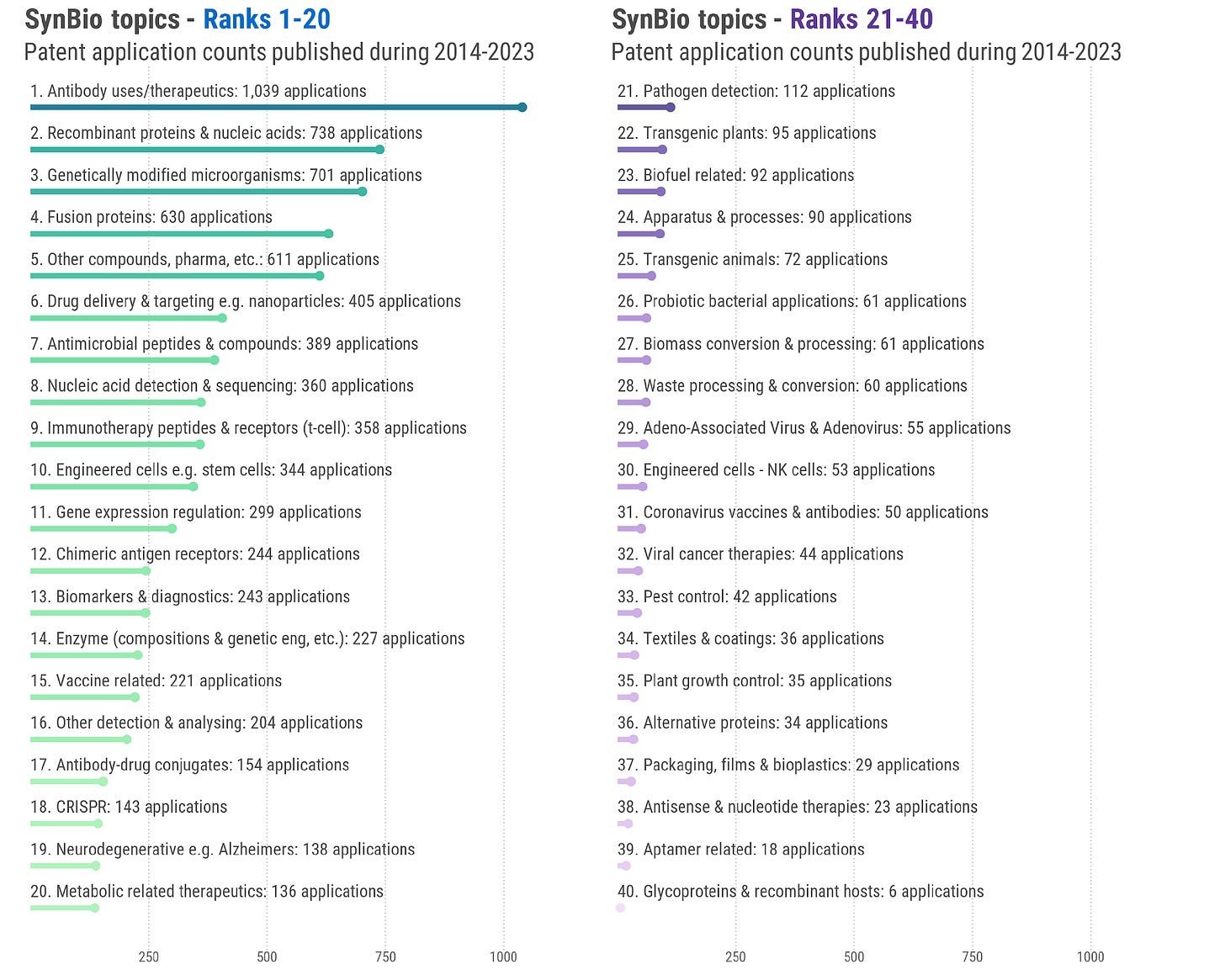
Figure 3: Top 40 fields for patent applications in China between 2004 and 2023.
Within the Chinese EPO syn bio applicant pool, activity is distributed across pharmaceutical companies, industrial biotechs, university labs, and state research institutes across multiple provinces. BGI, the largest single filer, has under 40 EPO applications in the 2014-23 window. No single entity dominates. That breadth signals ecosystem health in a way that concentrated patenting does not. Distributed ecosystems compound across more vectors and are harder to disrupt.
This picture is also likely an underestimate, for two distinct reasons.
First, the patent data skews heavily therapeutic, and that is not simply because that is where Chinese innovation is concentrated. It reflects which subsectors need global patent protection in the first place. Wave 1 industrial companies, Cathay, Meihua, Fufeng, do not need EPO patents. Their moats are operational: proprietary strains, fermentation parameters, process know-how built over decades. Trade secrets, not patents. Wave 2 therapeutics companies need global patent protection to enable the licensing deals that are their commercial model. The EPO data captures Wave 2 comprehensively and Wave 1 barely at all. The industrial competitive threat is substantially larger than the patent data alone suggests.
Second, the EPO dataset only captures globally-filing applicants. The domestic CNIPA filing universe is substantially larger, though much harder for a Westerner to analyse. The EPO data tells you what is approaching Western markets. The CNIPA data tells you what already exists domestically and may never need to cross the boundary.
Wave 3 inherits both blind spots above, and adds a timing problem on top. The dataset ends in 2023, just as these companies were being founded. There has barely been time for any of their activities, international or domestic, to register. What it does show, even on that partial view, is an ecosystem distributed across companies, universities, and state institutes growing exponentially. The parts that are missing are likely the ones Western start-ups should worry about the most.
What’s Being Built, and What It’s Already Breaking
The patent data showed a discovery layer that is wider and almost certainly bigger than the numbers alone suggest. That discovery layer is the input. What happens next is scale.
The scale-up infrastructure being built to take a discovered molecule from lab to commercial volume has no real comparison point anywhere else. The National Industrial Innovation Center for Bio-manufacturing in Shenzhen is 47,000 square metres across 17 floors, roughly double the size of Ginkgo’s flagship Biofab1, and when Dirk van der Kley asked the syn bio community on LinkedIn whether anyone could name an equivalent facility, nobody could. The 43 pilot plants named by MIIT and NDRC in November 2025 dwarf any comparable programme in the world, skewed heavily toward industrial applications. The national bioreactor mission has roughly 80 organisations working on 28 projects to engineer cheaper, higher-performance fermentation hardware. The Biomanufacturing Innovation Academy in Tianjin launched in December 2024 with RMB 6 billion to commercialise enzymes, amino acids, food additives, and functional sugars. And underneath all of it sit hundreds of CDMOs and CMOs, more than India, Japan, and South Korea combined.
This is what discovery feeding into infrastructure at this magnitude produces: capacity that outruns domestic demand. China’s PLA production is the clearest case. Domestic and global PLA consumption in 2024 sat around 120,000 and 260,000 tonnes respectively. Hisun alone produced roughly 50,000 tonnes and planned to triple that to 150,000 tonnes a year, with Kingfa, Jindan, and BBCA Biochemical expanding on the same trajectory. The result was predictable: exports rose 78% in 2024 while prices fell roughly 10%, and companies overexposed to PLA were left with razor-thin margins despite government subsidy. PBAT shows the same pattern from the petrochemical side, with capacity running at roughly 2.26 million tonnes against domestic sales of only 150,000 to 200,000 tonnes.
This is where scale stops being just a competitive advantage and starts foreclosing options. Export pricing in glutted categories is set by firms trying to offload excess inventory before margins erode further, not by ordinary cost competition. A Western producer doesn’t need to match Chinese efficiency in these categories. They need to match Chinese overcapacity, which is a different and much harder problem. For founders building in glutted molecules, building independently stops being a real option. The choice has already been made.
It is worth being honest that this is not free for China either. Thin margins, subsidy dependence, and at least one abandoned IPO (Blue Ridge Tunhe, in PBAT) show the financial strain real overcapacity creates. But that strain may be a perfectly acceptable cost from Beijing’s side. The financial losses are largely domestic and absorbable. The strategic gain, controlling which molecules can be produced where in the world and at what price, is external and durable. China has run this trade before, in solar and in EVs. The margins were thin and the business casualties were real, but the world still ended up dependent on Chinese supply chains for both. Biomanufacturing is the same trade, attempted one molecule at a time.
The smartest capital has already moved
If you want to know how seriously to take any of this, watch what some of the more sophisticated investors in the system are actually doing.
RA Capital, one of the largest life sciences investors in the world, doesn’t wait for Chinese biotech assets to surface anymore. It moved upstream, embedding itself inside labs and courting scientists before they publish, in some cases competing directly against Chinese VCs who are urging the same scientists not to publish at all. It has backed some of the most consequential outcomes in Chinese biotech to date, including Legend Biotech’s Carvykti, the first cell therapy of its kind to win FDA approval, and Gracell Bio, acquired by AstraZeneca for $1.2 billion in 2024.
In mid-2026, RA Capital went further. It launched Swiftbridge, a dedicated programme giving its more than 100 portfolio companies structured access to China’s clinical trial infrastructure, described by the partner who runs it as “Chinese clinical expertise in a box” for early-stage companies that don’t have the bandwidth to build those relationships themselves. The pitch is blunt: first-in-human approval timelines under three months, at a fraction of US cost. By the firm’s own account, no other VC has built anything like it yet.
The Machine Is Running
The question is not whether any of this is coming. It is how much of it has already arrived, and how much runway is left in the parts that haven’t.
Where the West still has leverage, and where it doesn’t, isn’t the same everywhere. In the categories already tipping into overcapacity, the contest is basically over: no amount of Western efficiency beats Chinese firms offloading inventory below cost. Trying to compete there head-on means competing on someone else’s terms. The leverage that’s left sits in two places: in which molecules get chosen before the capacity to make them exists, and in whether the West builds the lower layers of the stack, energy, feedstocks, fermentation, rather than only funding the AI-design layer sitting on top of infrastructure it doesn’t own.
None of this is decided. The West has real advantages: deep capital markets, world-leading science, firms leading on the hardest problems no one else has solved. What it hasn’t built is the rest of the stack underneath them, the energy, feedstock, and fermentation layers China spent two decades on before anyone was paying attention. Why not, and what to do about it, is the question the ECFR piece takes on directly. What’s clear here is simpler: the machine is running, and every year spent debating the answer is a year of runway lost.
This piece draws on patent analysis from Inevus Advanced Analytics and Potter Clarkson covering EPO synthetic biology applications 2004-2023; my own analysis of 884 Chinese biotech companies and 680 Chinese biotech services companies from Biotechgate with support from One Nucleus; the 2025 China Biomanufacturing Industry Development White Paper; field interviews across the Chinese biotech ecosystem in 2024-25; analysis from Dirk van der Kley’s Bio Brawl, Jacopo Gabrielli’s newsletter, and Jinbei Li’s industry writing; and my own mapping of the Asia-Pacific synthetic biology landscape.