Reading Writing And Editing Dna
Ai Digital Biology
Genomic Intelligence Models Integrated into Biomni Lab
Biomni Lab now incorporates Genomic Intelligence sequence-to-function models, enhancing biological research workflows.
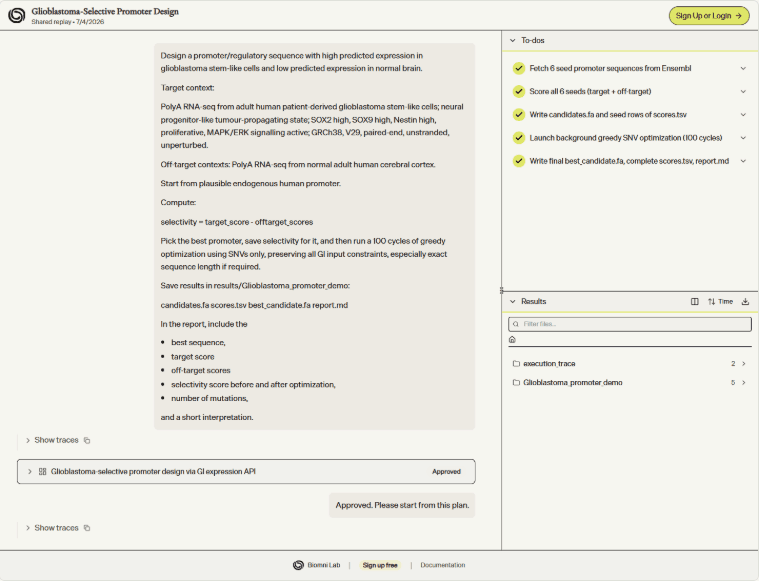
Biomni Lab has introduced a significant advancement by integrating Genomic Intelligence sequence-to-function models into its platform. This enhancement allows scientists to seamlessly transition from biological questions to reproducible computational workflows without the need to manually connect APIs, scripts, models, databases, and infrastructure.
Genomic Intelligence adds a vital capability to this workflow by providing models that read DNA sequences and predict biological activity. With this integration, Biomni can now utilize Genomic Intelligence models within natural-language research workflows, transforming tasks such as promoter design, expression prediction, regulatory sequence search, and variant interpretation into agent-executable actions.
Users can describe their biological sequence-function tasks in natural language, such as: “Design a promoter with high predicted expression in [target context] and low predicted expression in [off-target context].” The tasks can include starting from plausible endogenous human promoters, using Genomic Intelligence expression scoring, optimizing selectivity with SNVs only, and saving candidates, scores, the best sequence, and a report.
The importance of Genomic Intelligence lies in its ability to interpret the vast regulatory information contained within DNA sequences, which is crucial for understanding gene expression control. Despite the advancements in genome sequencing, accurately predicting the function of a sequence in a specific biological context remains a significant challenge that often involves repetitive wet-lab experiments.
Genomic Intelligence addresses this challenge by building genomic foundation models that predict functional outputs like gene expression and regulatory variant effects from DNA sequences. By incorporating these models into Biomni, researchers can enhance their scientific workflows, allowing them to specify biological contexts, score candidate regulatory sequences, optimize them, save outputs, and generate reproducible reports.
Biomni can utilize Genomic Intelligence models as model-backed scientific tools. The agent interprets the task, identifies the relevant Genomic Intelligence endpoint, checks input constraints, writes the necessary scoring and optimization code, executes model calls, tracks intermediate results, and returns both the final answer and the required files for workflow inspection or reproduction.
This orchestration is crucial because sequence design typically involves multiple model calls. A practical workflow often includes steps such as selecting biologically plausible starting sequences, scoring each sequence in both target and off-target contexts, defining a quantitative objective, iteratively optimizing the sequence while adhering to model constraints, and documenting all results.
As a practical example, Biomni was tasked with designing a promoter or regulatory sequence with high predicted expression in glioblastoma stem-like cells and low predicted expression in healthy adult brain tissue. The prompt specified the target context, which included characteristics from PolyA RNA-seq data, and defined selectivity as the difference between target and off-target scores.
Biomni utilized the Genomic Intelligence expression model as the scoring oracle, starting with six endogenous human promoter candidates and scoring each in the defined contexts. FOXM1 was identified as the optimal seed promoter based on its selectivity score.
Following this, Biomni conducted 100 cycles of greedy single-nucleotide variant optimization, accepting only the best mutations that improved selectivity. The final optimized sequence increased predicted selectivity significantly, showcasing the model's capacity to enhance expression in the target context while reducing it in the off-target context.
This end-to-end agentic design loop illustrates the power of integrating Genomic Intelligence into Biomni. The process involved interpreting biological goals, selecting appropriate promoters, scoring expressions, optimizing sequences, and generating comprehensive reports, all of which contribute to a more streamlined and reproducible scientific workflow.
It is essential to recognize that these predictions are computational and have not yet undergone experimental validation. Future steps may include broader off-target scoring, motif analysis, and wet-lab validation to enhance specificity and confirm predictions.
The integration of Genomic Intelligence within Biomni Lab opens up exciting possibilities for researchers in areas such as promoter design, regulatory variant interpretation, expression-guided sequence engineering, and enhancer screening, ultimately transforming DNA sequences into testable biological hypotheses.