Ai Digital Biology
Bio Design
Potato Just Launched the Tool It Wishes It Had as a Lab Scientist

Walk through enough biology startups and you start noticing the same thing: an expensive liquid handler sitting in the corner, unused. Ask about it and you get a shrug.
The robot usually isn't the problem. The hard part is getting from an assay that works at the bench to an experimental design and protocol that can actually take advantage of it.
Potato opened early access to the Optimizer recently. The tool targets a problem every bench scientist knows well: designing and optimizing an assay across multiple variables is hard enough. Translating that experiment into something automation can reliably execute adds another layer of work.
Automation Is a Translation Problem
A scientist knows what they want to learn. Turning that into a design that tests eight variables at once, then into a plate map, then into something a machine can execute, are separate skills entirely. Most bench scientists were never taught it. And even in labs with automation expertise, that translation takes time.
So the work stays manual: one condition at a time, in a 96-well plate, with an Excel table on the side to keep track of what went in well D7.
This isn't a budget problem, and it isn't a startup problem.
“Even large organizations are not using design of experiment to do assay development. And you're like, why? Because it's hard. Because the tools that are available are hard to use.”
— Merrit Savener, Chief Commercial Officer, Potato
She’s also quick to clarify what Potato means by higher-throughput experimentation, because the phrase itself can make the problem sound much bigger than it is.
“People hear ‘high throughput’ and think they need to be operating at Ginkgo scale. That’s not what we mean. If you’re already doing something repeatedly in a 96-well plate, there may be a much better way to use those wells.”
— Merrit Savener, Chief Commercial Officer, Potato
That's the gap: not a self-driving lab, but a scientist who already knows there are more informative ways to run an experiment and doesn’t have an easy route from here to there.
Start With the Protocol, Not the Machine
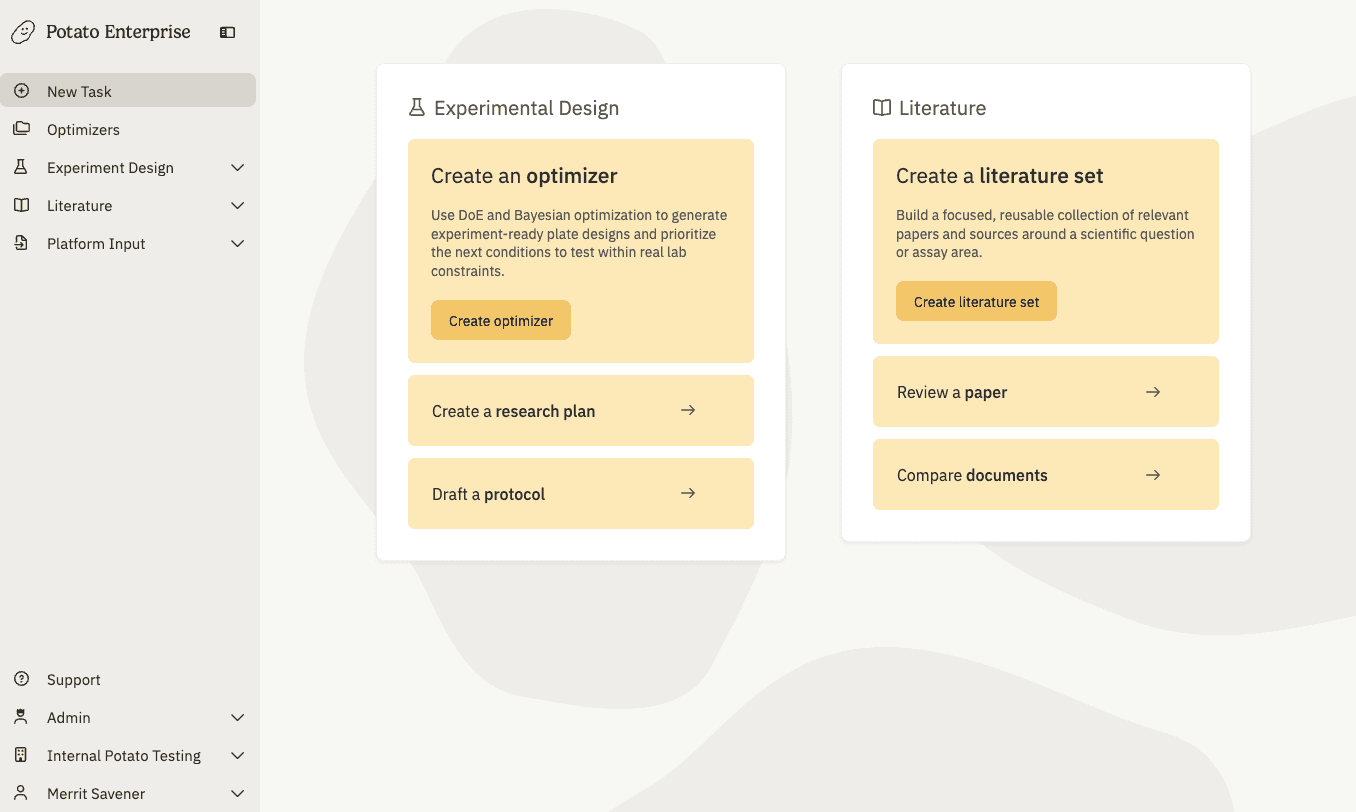
The Optimizer's bet is that experimental design, protocol development, and automation need to be treated as one connected workflow.
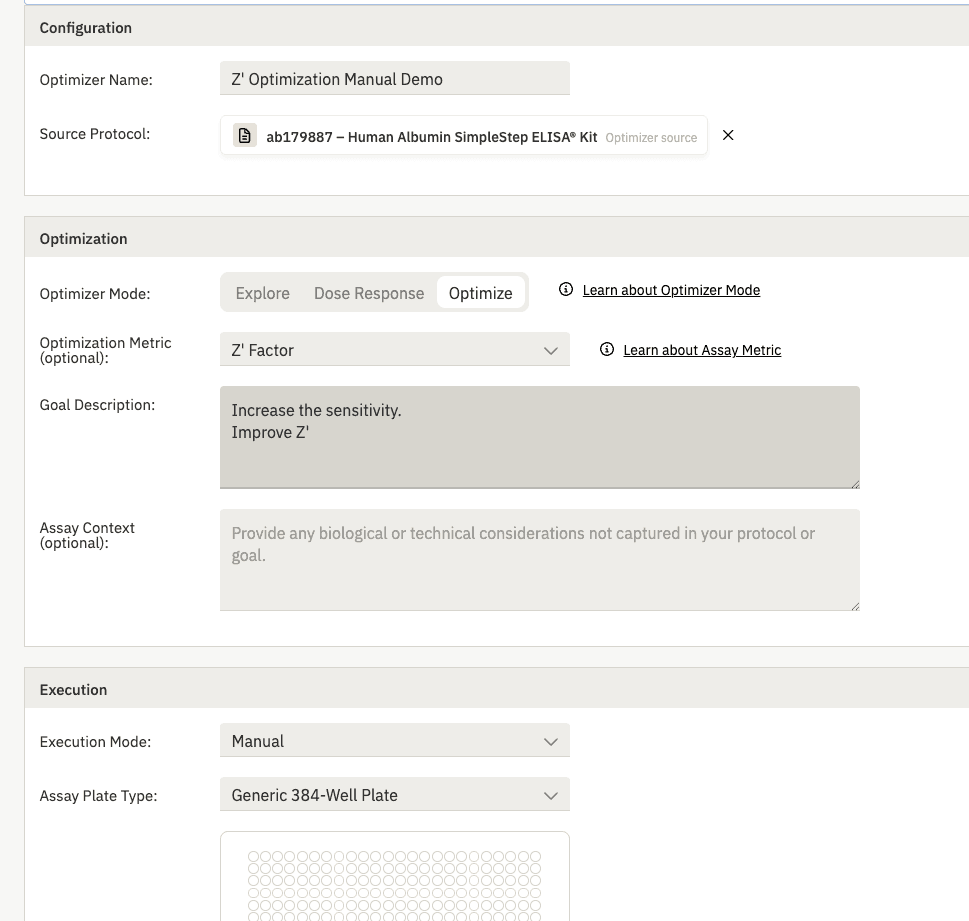
You give it the ELISA kit spec sheet you downloaded from R&D Systems. You tell it what you want that assay to do differently, say a tighter sensitivity range. Then you tell it what your lab actually has: this robot, this labware, only 96-well plates. Those constraints carry through every downstream step.
The system can turn that starting point into a multivariable experimental design, a written protocol you can run by hand, plate maps, and worklists or scripts for your instruments. Run it, feed the results back, and it identifies which condition performed best and recommends what to test next if you're still not where you want to be.
It pulls literature in along the way, so the hours normally spent hunting for an antibody concentration or a primer melting temperature disappear into the design step. And where the math matters, Potato uses deterministic calculations rather than asking a language model to guess: volumes, concentrations, and dilution series get calculated, not generated.
Scripts currently output to Opentrons, which has become the default entry point for lab automation largely because it's open and easy to build against, compared to legacy platforms like Hamilton and Beckman Coulter. Other robots are on the roadmap, and Potato says the vendor relationships are already in place.
For labs without automation at all, the Optimizer can still produce structured protocols, plate maps, and worklists that make the experiment easier to execute manually or hand off to an automation team later.
Built for the People Who Make Experiments Work
Most AI-in-biology money is pointed at drug discovery: hypothesis generation, molecule design, target identification. All of that eventually runs into the same physical constraint. Someone still has to design an experiment that can test the idea and generate reliable data.
Potato is aimed at the person whose job is to make the assay work in the first place.
That's a deliberate narrowing, sharpened by listening closely to early customers. Last fall the company launched Tater, its AI scientist, and the response pointed it toward an even bigger opportunity.
“What we heard from people was like, this is cool, but this isn't quite solving the problem that I need.”
— Merrit Savener, Chief Commercial Officer, Potato
So Potato narrowed its focus around experimental execution.
“The tool doesn’t need to do everything. It needs to help you get from the experiment you want to run to something you can actually execute.”
— Merrit Savener, Chief Commercial Officer, Potato
The interface reflects that. You aren't prompting a chatbot and hoping. You're stating a request: this assay, more sensitive, on this robot, with these plates. The system's job is to figure out the rest and hand you something you can actually run tomorrow.
Less Time Perfecting Assays, More Time Thinking About Science
Savener spent a decade at the bench before moving commercial, and she's candid about why she left.
“I left the lab because I hated pipetting things. I love science and am passionate about science, but transferring tiny amounts of liquid back and forth between small plastic tubes was the whole experience.”
“If I had had the Optimizer, if I had had the whole Potato platform and some robots, maybe I would still be a bench lab scientist.”
— Merrit Savener, Chief Commercial Officer, Potato
That's the honest version of the pitch. Not that AI will do your science, but that the weeks you currently spend getting an assay to behave are weeks you didn't spend thinking about what the assay is for.
Potato is building software for that workflow, rather than becoming a lab services company itself.
“We're not a service provider. We want to give scientists and lab teams the tools to do this themselves.”
— Merrit Savener, Chief Commercial Officer, Potato
The company does maintain an Opentrons system in a shared lab space, staffed by its own engineers, but its job is validation: making sure every protocol the Optimizer generates actually runs before it reaches a customer's bench. We agreed it should probably be named the Deep Fryer.
Early access is open now, with customers selected for scientific fit rather than opened broadly. Because as Savener put it, you gotta start with your potato before you make some fries.