Jason Gammack: The Constraints Were Always Manufacturing Artifacts
In an exclusive conversation ahead of his appearance at SynBioBeta 2026 on May 4-7th in San Jose, Jason T. Gammack previewed his talk that reframes the synthetic biology bottleneck most researchers have learned to live with. The CEO of Ansa Biotechnologies argues that the limits scientists routinely design around are manufacturing artifacts inherited from a generation of chemical synthesis providers that never caught up with what modern workflows demand.
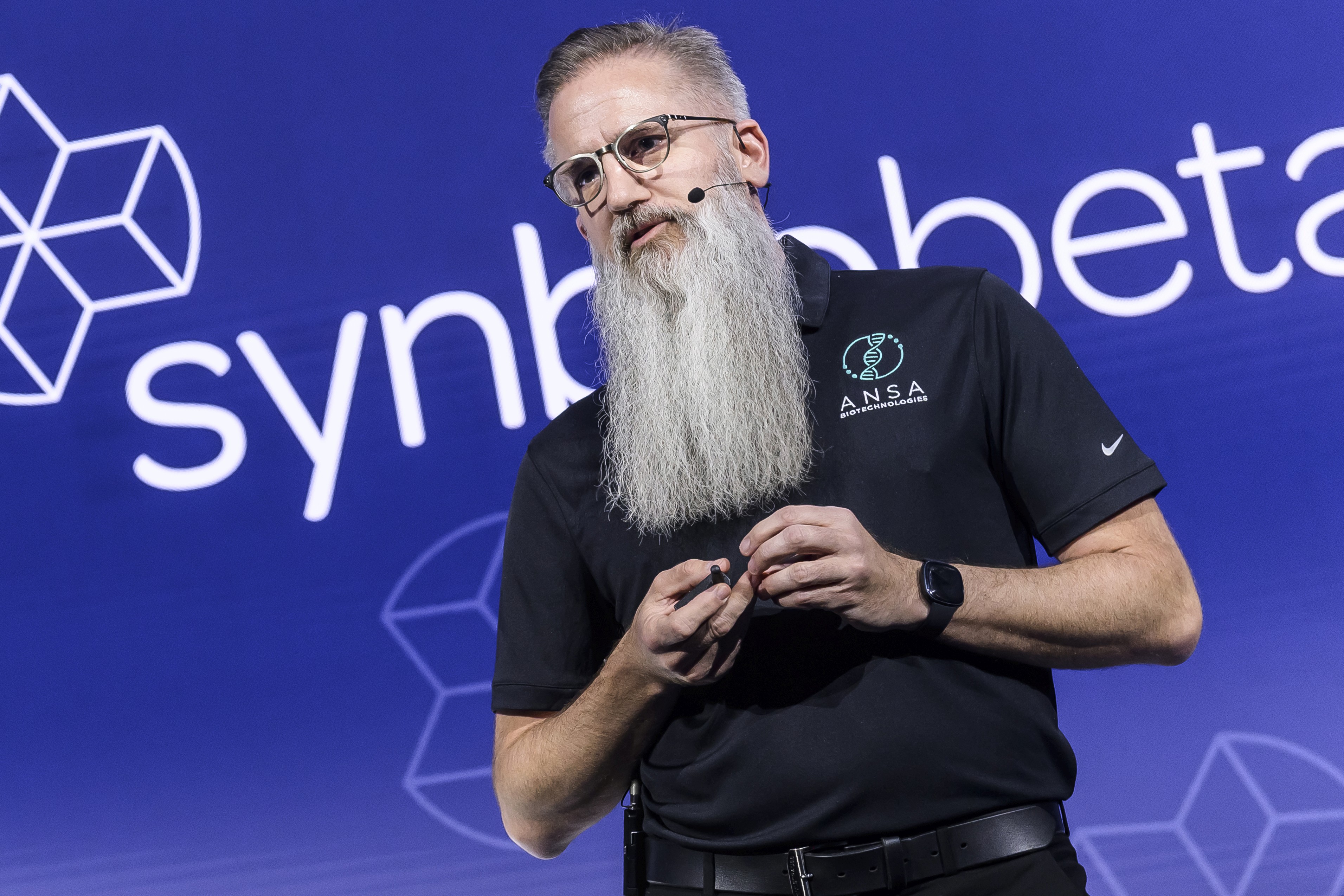
"The constraints they've been taught to accept are not laws of nature. They're artifacts of legacy manufacturing."
Gammack came to Ansa as its first commercial CEO after more than three decades in biotech, a career that began in the early 1990s and has tracked the field's transition from observation to engineering. That long view is part of what makes him bullish on the present moment. "It's one of the few fields ambitious enough to merit the hype," he said.
The technical foundation is a fully enzymatic synthesis platform built on TdT-dNTP conjugates, an approach first described by Ansa co-founders Dan Arlow and Sebastian Palluk in Nature Biotechnology. Each conjugate tethers a single nucleotide to a terminal deoxynucleotidyl transferase enzyme, adding one base at a time in aqueous conditions and then releasing through linker cleavage. Avoiding the harsh chemistry of phosphoramidite synthesis preserves strand integrity at lengths where chemical methods historically degrade, which is how Ansa pushes past the roughly 10 kilobase ceiling that has long defined assembled gene synthesis.
In October 2025, that platform produced a commercial first. Ansa launched a 50 kilobase sequence-perfect clonal DNA product, the longest synthetic DNA construct on the market, with turnaround times under 25 business days and pricing as low as 28 cents per base pair. The launch followed an early access program with more than 20 institutions, including the Allen Institute's Seattle Hub for Synthetic Biology and Applied StemCell. The company reports a fulfillment rate above 97 percent on long, complex constructs.
What makes the offering commercially distinctive is the Ansa On-Time Guarantee. If a complete order ships late, the customer pays nothing. That kind of service level agreement is standard for catalog reagents and unprecedented for custom genes, where missed deadlines have long been treated as the cost of doing science.
The commercial confidence is backed by fresh capital. In October 2025, Ansa closed an oversubscribed Series B of 54.4 million dollars, led by Cerberus Ventures with participation from Fall Line Capital, AIM13, Black Opal Ventures, and existing investors, bringing total funding to more than 134 million dollars. Proceeds will expand domestic manufacturing capacity and feed development of integrated tools that combine sequence design, manufacturability assessment, and ordering in a single workflow.
Gammack expects the demand pattern to keep shifting. AI-driven design now generates constructs that older synthesis platforms struggle to produce, and the next wave of orders is moving toward assembled multi-construct systems and large libraries rather than single genes. The pitch he wants the SynBioBeta audience to leave with is direct.
"You should design for the biology you want to build, not for the process limitations of a supplier that's been holding the field back."